As anyone who’s pointed their phone at a foreign menu lately knows — machine translation has come a long way.
Once the punchline of countless jokes, tools like Google Translate are now impressively useful for everyday phrases and basic understanding. But what happens when we go beyond “Where’s the bathroom?” and try to apply AI to art — to literature?
That’s where things get complicated.
Controversy in the Publishing World
When Dutch publisher Veen Bosch & Keuning announced it would use AI to help translate commercial fiction, the backlash was immediate. Translators and authors pushed back — hard.
Their concern wasn’t just about job loss. It was about craft.
“A translator translates more than just words,” said Michele Hutchison, Booker Prize–winning translator of The Discomfort of Evening. “We build bridges between cultures.”
She’s not wrong. A good translator makes invisible decisions: how to preserve rhythm, how to express metaphor, how to help readers understand cultural references — often without them realizing it. And yes, sometimes that involves researching the correct term for agricultural machinery in the middle of a novel.
Where AI Still Falls Short
Even its defenders admit that AI-generated translations require serious post-editing — ideally by someone who knows both languages fluently. At that point, you might ask: why not just have that person do the whole thing?
Juno Dawson, author of Her Majesty’s Royal Coven, offers a concrete example:
“A reader flagged a problematic term used to describe a trans person in a French edition of one of my books. We were able to fix it before publication. That’s the kind of nuance I doubt AI would catch.”
When stakes are high, when identity, representation, or poetry is on the line — authors are right to be cautious.
Where AI Might Help
And yet, it’s not all black and white.
For authors writing in minority languages, who may never have their work translated otherwise, AI can be a bridge — a first step toward visibility. For indie game developers working in 40 languages on a budget, AI might offer an alternative to skipping translation altogether.
Dr. Jack Ratcliffe, CEO of Noun Town — a language-learning video game with over 50,000 lines of dialogue — knows this challenge firsthand.
“If the text is ‘Press A to jump,’ AI translation works. But once there’s nuance, dialogue, characters? I’d be terrified to rely on AI.”
His team ended up using only human translators and teachers to check every line.
Utility vs. Art
This debate boils down to one key distinction: utility vs. craft.
Few would object to AI helping decode a phrase, like a smart dictionary. But literary translation isn’t just about getting the meaning across — it’s about how it’s said. It’s an art form of its own.
As Hutchison put it:
“I’ve started adding a note: ‘hand-crafted without the use of generative AI.’ Translators are artists too.”
When AI Becomes a Tool — Not a Shortcut
Still, what if AI weren’t a replacement, but a starting point?
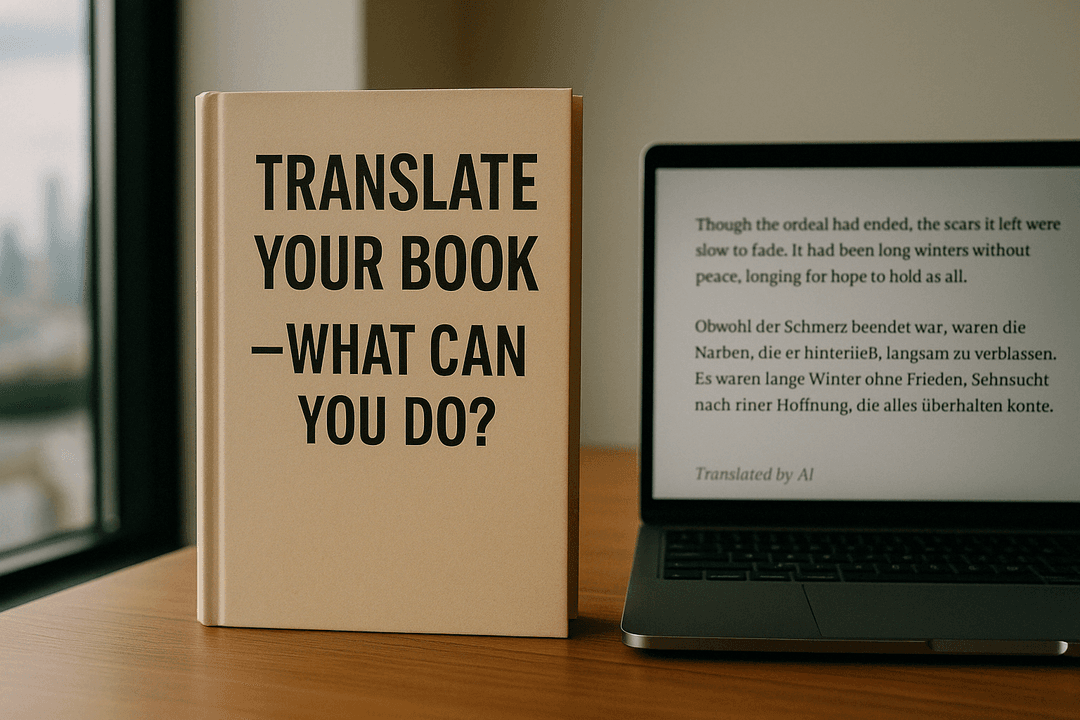
That’s the idea behind tools like Atlazis — a platform that uses advanced AI to translate full-length books, while giving the author control over tone, voice, and formatting. The result isn’t just a raw draft — it’s a polished translation that can be edited, refined, and shaped into something beautiful.
For authors who don’t have a €6,000 translation budget… that can mean the difference between being read globally or not at all.
Let Your Story Travel
You don’t have to choose between bad AI and expensive human-only workflows.
With Atlazis, you can keep your voice — and reach readers across languages.
Try Atlazis today and translate your book with AI built for storytelling.